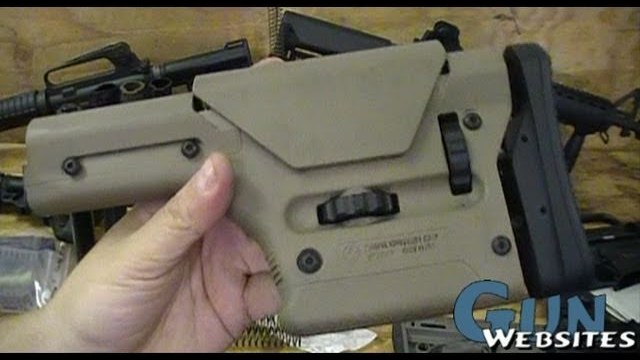
Collapsible carbine stocks get most of the attention, but the fixed rifle stock is where the AR-15 started. The second video in the Gun Websites AR15 Stocks series looks at rifle stocks and how they differ from carbine stocks.
Rifle vs. carbine
- A carbine stock slides on the receiver extension to lengthen or shorten the rifle.
- A rifle stock has no adjustment. It is one length, as on the original AR-15 and M16.
Classic rifle stocks
- The early style is hollow, strong polymer with a rubberized butt pad held by two screws and a sling swivel for a military-style sling.
- The later style adds a trap door in the butt plate. Press the plunger with a bullet tip or pen and the door opens to a compartment for a cleaning kit with a collapsible rod and patches.
How it attaches
- A rifle stock needs no castle nut or receiver end plate.
- The longer rifle receiver extension fills the entire stock and threads into the lower receiver, and a screw through the butt plate holds the stock in place.
- Rifle stocks also use a longer rifle buffer and spring. Do not mix rifle and carbine parts.
Modern rifle stocks
- Adjustable precision stocks, such as the Magpul PRS, fit on the rifle tube and add cheek height and length-of-pull adjustment, sling mounts and a support-hand hold. They weigh more than a basic stock.
Why choose a rifle stock
- Carbine stocks are far more popular, with many more options.
- A fixed rifle stock is solid enough to slam against the ground, which is sometimes used to clear a stubborn malfunction, and to fight with the rifle.
More
- See the AR15 Stock and Receiver Extension pages, and AR-15 Basic Anatomy for First-Time Buyers.
Based on a video from the Gun Websites YouTube channel. New to the AR-15? Start with Where To Start.